
 In his 1704 treatise on the theory of optical phenomena (Opticks), Sir Isaac Newton wrote that "light is never known to follow crooked passages nor to bend into the shadow". He explained this observation by describing how particles of light always travel in straight lines, and how objects positioned within the path of light particles would cast a shadow because the particles could not spread out behind the object.
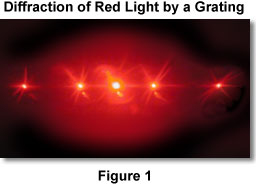
On a large scale, this hypothesis is supported by the seemingly sharp edges of shadows cast by rays from the sun. However, on a much smaller scale, when light waves pass near a barrier, they tend to bend around that barrier and spread at oblique angles.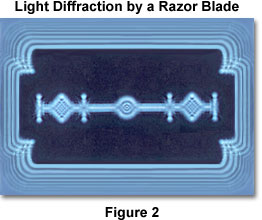 This phenomenon is known as diffraction of the light, and occurs when a light wave passes very close to the edge of an object or through a tiny opening, such as a slit or aperture. The light that passes through the opening is partially redirected due to an interaction with the edges. An example of light diffraction is presented in Figure 1 for coherent red laser light passing through a very tiny line grating composed of a series of bars on a glass microscope slide. The bars diffract the laser light into widely spaced periodic beams of bright light that can be observed in the figure.
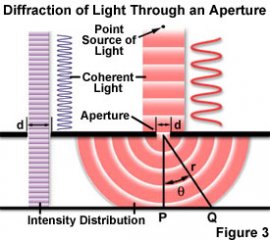 Diffraction is a phenomenon similar to dispersion, but is not related to a variation in the wavelength of light.
Bright bands that are often seen inside the edges of geometric shadows are the result of diffraction. When light waves originating from a distant point of light strike an opaque object, they tend to bend around the edges, curving both into the shadow and back through the path of other light waves from the same source. The waves that bend around behind the object create a bright line where the shadow would ordinarily begin, but waves that bounce back into the path of the light overlap waves from the source, creating an interference pattern of light and dark bands around the edge of the object (see Figure 2). Diffraction is often explained in terms of the Huygens principle, which states that each point on a wavefront can be considered as a source of a new wave.
Depending on the circumstances that give rise to the phenomenon, diffraction can be perceived in a variety of different ways. Scientists have cleverly utilized diffraction of neutrons and X-rays to elucidate the arrangement of atoms in small ionic crystals, molecules, and even such large macromolecular assemblies as proteins and nucleic acids. Electron diffraction is often employed to examine periodic features of viruses, membranes, and other biological organisms, as well as synthetic and naturally occurring materials. No lens exists that will focus neutrons and X-rays into an image, so investigators must reconstruct images of molecules and proteins from the diffraction patterns using sophisticated mathematical analysis. Fortunately, magnetic lenses can focus diffracted electrons in the electron microscope, and glass lenses are very useful for focusing diffracted light to form an optical image that can easily be viewed.
Share this Post
latest post
-
 What is the diffraction of Light? February 6, 2026
 -
 Wolf Blitzer hologram January 27, 2026
 -
 Minority Report hologram January 14, 2026
 -
 Gold Holographic January 4, 2026
 -
 Mirror hologram December 25, 2025
 -
 Holographic Fabric December 15, 2025
 -
 IPad hologram projector December 5, 2025
 -
 Christmas Hologram November 25, 2025