
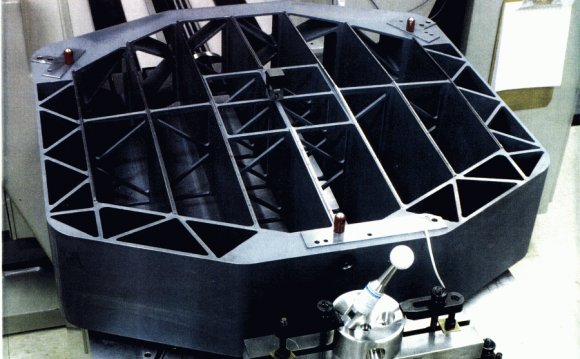
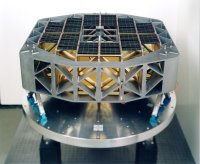
 Privileged visitors to the ESTEC clean rooms during the final integration of XMM-Newton noticed that after the installation of the flight-model mirror modules, there appeared to be something missing. Only two of the three mirror modules project out of the support platform. The lack of symmetry stems from the fact that only two of the mirror modules are equipped at their exit with reflection grating arrays. With the associated cameras, they are part of the Reflection Grating Spectrometer (RGS) component of the XMM-Newton mission.
 Dispersive spectroscopy fans out X-ray photons much as a prism does with visible light. It was a relatively new technique at the time and XMM-Newton is the first ever X-ray space observatory to be equipped with reflection gratings operating in the X-ray band of the electromagnetic spectrum.
Early X-ray missions carried Bragg-crystal spectrometers; later missions like EXOSAT (1983) used transmission gratings. XMM-Newton is the first mission to use the latest technology which makes it possible to produce large reflection grating plates, giving simultaneously a high spectral resolution and throughput.
Reflection grating
 |
|
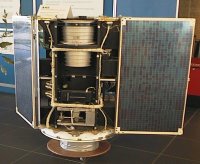
One of XMM-Newton's two reflection grating arrays |
A reflection grating is a mirror with tightly controlled grooves on it, in the case of RGS about 645 grooves per mm, equivalent to 65 grooves in the width of an average human hair! X-rays reflected off the top and the valley of the grooves interfere with each other and cause a spectral image whereby X-rays of different wavelength (or energy) are reflected under slightly different angles.
The two reflection grating arrays (RGA) on XMM-Newton are each composed of 182 such grating plates. Each plate consists of a silicon carbide substrate coated with a thin (2000 Å) film of gold. Measuring 10 × 20 cm, they were produced by a replication process from a mechanically ruled master. The grating plates, with stiffening ribs on their rear side, are integrated onto a beryllium support structure.
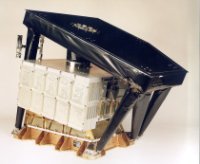
One of the RGS cameras tucked behind its cooling radiator. The opening in the black radiator shows the connection to the cold finger that cools the inside of the camera.
Once splayed out into a spectrum, the X-rays are focused on the two RGS cameras in the spectral focal plane geometrically offset with regard to the EPIC cameras. The two grating arrays disperse about 40 per cent of the incoming light onto the RGS cameras, while 44 per cent of the radiation is directed onto the EPIC cameras at the telescope's prime focus. The remaining light is absorbed by the support structures of the RGAs.RELATED VIDEO



Share this Post
latest post
-
 Uses of diffraction October 24, 2026
 -
 Applications of diffraction Gratings October 14, 2026
 -
 Scott hologram goggles October 4, 2026
 -
 Reality hologram September 24, 2026
 -
 Holographic smartphone September 14, 2026
 -
 Wavelength order September 4, 2026
 -
 Types of Holography August 25, 2026
 -
 Smartphone hologram projector August 15, 2026